
Module One: Terminology, Communication, and Considerations
1.1 Terminology
Why Language Matters
Disclaimer: Every individual is unique, with their own preferences and intersectionality that affects their disabled lived experiences. The most important consideration when discussing disability is the preferences of the person you’re working/speaking with.
The way we describe disability directly shapes attitudes, expectations, and inclusivity. Words can either reinforce stereotypes and stigma or promote dignity and respect. Historically, disability-related terms have been used as medical labels, insults, or metaphors. Modern best practices emphasize listening to individuals respecting identity preferences and recognizing disability as a natural aspect of human diversity.
Video: How I Move Through the World
In this video, Rebekah shares how she personally describes her disability and wheelchair use, offering insight into how language reflects a person’s identity. Her perspective highlights the importance for genetic counselors to listen and honor individual language preferences.
- Impact of words: Terms like “retarded” or “crippled” have been used to justify exclusionary policies and discrimination. Even casual jokes like “I’m so OCD” minimize real conditions.
- Cultural importance: Many disabled communities (e.g., Deaf Culture) see language not just as descriptive, but as central to identity and pride.
- Professional responsibility: For genetic counselors, choosing language carefully is crucial for building trust, reducing harm, and supporting informed decision-making.
Person-First Language (PFL) and Identity-First Language (IFL)
Two main approaches are widely used:
Different communities / identities use PFL or IFL, both are appropriate based on the values and needs of each individual. There isn’t one correct way!
Person-first language (PFL)
Emphasizes the individual before the condition e.g., “person with a disability,” “person with autism”). This is often favored in clinical and educational contexts because it highlights personhood first
Identity-first language (IFL)
Places the disability first (e.g., “disabled person,” “autistic person”). Many disabled advocates prefer this because it reflects pride and recognition of disability as integral to identity
Best Practice for Counselors
Ask each person their preference whenever possible. If unsure, PFL is generally more used in clinical settings.
Recognize that preferences vary by community (e.g., Deaf communities often prefer IFL).
Patient-centered examples on how to ask:
- Example 1: Asking About Language Preferences (General)
“Before we continue, I want to make sure I’m using language that feels respectful to you. Do you have a preference for how you’d like me to talk about your diagnosis?” - Example 2: Offering Both Options
“Some people prefer person-first language, like ‘person with autism,’ while others prefer identity-first language, like ‘autistic person.’ Is there a way you prefer I refer to this when we talk today?” - Example 3: When Speaking with a Parent or Caregiver
“When we’re talking about your child, what language feels most comfortable or accurate for your family? And if your child has a preference, we’re happy to follow that.”
Further Resources for Learners
Peer-reviewed literature:
- Clinical genetic counselors use of people- and identity-first language in regard to patients’ identification with disability- (Lepard T, Dugan M, Cleveland E, Menke C. Clinical genetic counselors’ use of people- and identity-first language in regard to patients’ identification with disability. J Genet Couns. 2025 Apr;34(2):e1972. doi: 10.1002/jgc4.1972. Epub 2024 Sep 11. PMID: 39262055; PMCID: PMC11953575.)
- Preferences for Identity-First and Person-First Language: A Systematic Review of Research with Autistic Adults/Adults with Autism- Schuck, R.K., Chetcuti, L., Dwyer, P. et al. Preferences for Identity-First and Person-First Language: A Systematic Review of Research With Autistic Adults/Adults With Autism. J Autism Dev Disord (2025). https://doi.org/10.1007/s10803-025-07174-3
- Blog: Alliance of Disability Advocates-Our New Disability Language Series
https://adanc.org/person-first-vs-identity-first-language/

Reflection Prompt for Learners:
How might you respond if a patient and their family prefer different language when talking about disability?
Terms to Avoid and Why
| Outdated / Problematic Term | Respectful Alternative |
| Wheelchair bound | Person who uses a wheelchair |
| Normal person | Non-disabled person |
| Suffers from | Lives with/has |
| Handicapped parking | Accessible parking |
| Retarded | Person with an intellectual disability |
| Special-needs student | Student with a disability |
| Victim of | Person with a disability |
Categories of Terms
Medicalized or Negative Labels
Avoid: handicapped, invalid, suffers from, afflicted with, wheelchair-bound, defective.
Use: person with a disability, wheelchair user, person living with [condition].
Why: these older terms suggest pity, inferiority, or medical pathology rather than inclusion.
Condescending Euphemisms
Avoid: special, differently abled, handi-capable, inspirational.
Use: disabled person, person with disabilities.
Why: euphemisms often infantilize or avoid the reality of disability, implying it is too shameful to name directly.
Insults and Slang
Avoid: retarded, dumb, crazy, lame, spaz, midget.
Use: alternatives that describe the intended meaning (e.g., “person with dwarfism”).
Why: many insults originated as medical terms and have caused long-term harm.
Inaccurate or Misleading Language
Avoid: normal, able-bodied, hearing impaired, visually impaired (preferred less often).
Use: non-disabled, Deaf/hard of hearing, blind/low vision.
Why: “normal” implies disabled people are abnormal; “impaired” centers deficiency.
Video: Challenging Pity-Based Narratives in Deaf Communities
This clip explores how pity and “inspirational” framing toward Deaf individuals can be harmful, even when intended as kindness. It highlights why shifting from sympathy to respect is essential for inclusive, disability-informed care.
Further Resources for Learners
- Additional Content: Inspiration Porn-Stella Young
Reflection Prompt for Learners:
Case: You hear a colleague say, “This couple is really worried because their child is suffering from autism.”
Prompt: How might you respond in this situation to educate a colleague while maintaining respect and a collaborative working relationship?
Case continued: In the moment, you pause and gently respond, “I’ve noticed that some families and individuals with autism prefer different language. Instead of ‘suffering from,’ I often say ‘autistic’ or ‘has autism,’ depending on what the family prefers. Later, when speaking with the family, you model this approach by asking, “How do you prefer we use the term autism when talking about your child’s needs?”
This small shift creates space for the family’s voice, avoids harmful assumptions, and demonstrates how genetic counselors can serve as educators.
Specific Community Considerations
Deaf/Hard of Hearing
Use lowercase deaf for audiological description. For individuals who identify culturally with the Deaf community, you use capitalized Deaf. Avoid hearing impaired.
Autism & Neurodiversity
Many autistic self-advocates prefer identity-first (“autistic person”), rejecting deficit-framed labels like autism spectrum disorder. Terms like “high functioning” and “low functioning” oversimplify and stigmatize.
Mental Health
Say person living with depression or person experiencing bipolar disorder. Avoid terms like psycho or deranged.
Mobility & Wheelchair Use
Say wheelchair user rather than confined to a wheelchair, which ignores the independence wheelchairs provide.
Dwarfism
Use the term dwarfism or use their medical diagnosis if patient gravitates towards that language. Example being “individual with achondroplasia.” Avoid the term midget.
How do you ask if an individual is a part of the cultural Deaf community?
- Example 1: “People who are Deaf or hard of hearing identify in different ways. Do you identify as part of the Deaf community?”
- Example 2: “Some people see being Deaf as part of their cultural identity and community, while others do not. How do you identify?”
- Example 3: “Do you identify as Deaf, hard of hearing, or something else? And are you part of the Deaf community?”
Everyday Practice for Counselors
Contextualize: Only mention disability when it is relevant (e.g., in discussing accommodations, care, or health context).
Ask, don’t assume: Language preferences can differ even within the same condition.
Challenge metaphors: Phrases like “blind-sided” or “fall on deaf ears” casually use disability as a metaphor and can perpetuate harm.
Avoid stereotypes: Don’t label patients as “inspirational” for living everyday lives. Recognize achievements the same way you would for anyone else.
Practice Scenarios: What Could You Do Instead?
Scenario 1: Results Disclosure
Instead of saying:
“I’m sorry your child suffers from muscular dystrophy.”
Say:
“Your child has muscular dystrophy. Let’s talk about what supports and resources are available.”
Scenario 2: Medical Documentation
Instead of writing:
“wheelchair-bound patient, abnormal development.”
Write:
“patient who uses a wheelchair, atypical development.”
Scenario 3: Counseling Conversation
If a patient says:
“I’m autistic, not a person with autism.”
Respond:
“Thank you for letting me know. I’ll use ‘autistic’ when we talk.”
Key Takeaways
🔑Takeaway 1
Language shapes inclusion, dignity, and patient trust.
🔑Takeaway 2
Both person-first and identity-first language are valid, so ask individuals their preference.
🔑 Takeaway 3
Avoid medicalized, euphemistic, or insulting terms.
🔑 Takeaway 4
Use clear, accurate language that avoids pity, stereotypes, or metaphors.
🔑 Takeaway 5
Respect that language evolves; stay engaged with community voices and updated guides.
Glossary of Disability-Inclusive Terms
Disclaimer: Some communities recognize multiple terms as appropriate. This list is not exhaustive of terms used.
Accessible: Describes environments, facilities, or materials designed so people with disabilities can use them equally (e.g., accessible parking, accessible bathrooms).
Autistic person / Person with autism: Both terms are valid depending on individual preference. “Autistic person” reflects disability pride and identity-first language, while “person with autism” follows person-first language.
Blind / Low Vision: Refers to individuals with total or partial vision loss. Some people prefer blind as an identity term, while others may identify as low vision or legally blind.
CODA (Child of Deaf Adult): A CODA is a hearing individual who has one or more Deaf parents or caregivers. CODAs often grow up navigating both Deaf and hearing cultures, frequently using sign language and sometimes taking on roles such as interpreting or bridging communication between their family and the hearing world.
Deaf / Hard of Hearing: Refers to individuals with varying degrees of hearing loss. Deaf (capital D) often refers to members of the cultural and linguistic Deaf community. Hard of hearing is appropriate for people with partial hearing loss.
Disabled person / Person with a disability: Both are widely accepted. “Disabled person” reflects the social model (barriers disable individuals), while “person with a disability” reflects person-first emphasis on humanity.
Identity-first language (IFL): A linguistic approach that places disability first (e.g., “disabled person”). Commonly used within disability rights communities as a marker of identity and pride.
Intellectual Disability: Refers to limitations in intellectual functioning and adaptive behavior. This is the preferred clinical and educational term.
Invisible disability: Describes disabilities not immediately apparent, such as epilepsy, chronic illnesses, or some mental health conditions.
Mental health disability: A respectful way to describe conditions such as depression, anxiety, or bipolar disorder. Phrases like person living with [condition] or person experiencing [condition] are also appropriate.
Neurodiversity / Neurodivergent: Refers to natural variations in brain development and functioning, including autism, ADHD, dyslexia, dyspraxia, and others. Neurodivergent describes individuals whose cognitive functioning differs from what is considered ‘normal’ by societal standards.
Neurotypical: A term describing individuals whose neurological development and functioning align with socially defined norms, often used in contrast to neurodivergent.
Non-disabled person: Refers to someone without a disability. Preferred over “able-bodied” or “normal,” which imply that disability is abnormal.
Person-first language (PFL): A linguistic approach that puts the person before the disability (e.g., “person with a disability”). Often used in healthcare and education.
Spoonie: A “spoonie” is a person living with a chronic illness, disability, or condition that affects their energy levels. The term comes from the “Spoon Theory,” which uses spoons to represent limited daily energy — each activity costs a certain number of spoons, and once they’re gone, the person must rest.
Wheelchair user: Refers to a person who uses a wheelchair for mobility. Recognizes the wheelchair as a tool of independence rather than confinement.
Reflection Prompt for Learners:
Think of a time you heard or used disability-related language that might not align with these guidelines. How could you re-frame that phrase using respectful, inclusive terminology?
1.2 Approach to Communication
Why Communication Matters
Effective communication is not optional; it is both a legal requirement under the Americans with Disabilities Act (ADA) and a cornerstone of patient-centered care. Breakdowns in communication often result in misunderstandings, reduced trust, and even medical errors. For patients with disabilities, respectful communication affirms their autonomy and dignity, while inadequate strategies can perpetuate exclusion and harm.
Core Principles of Disability Communication
Key practices for inclusive and respectful interaction. Integrated Practice: ensure all principles are applied together.
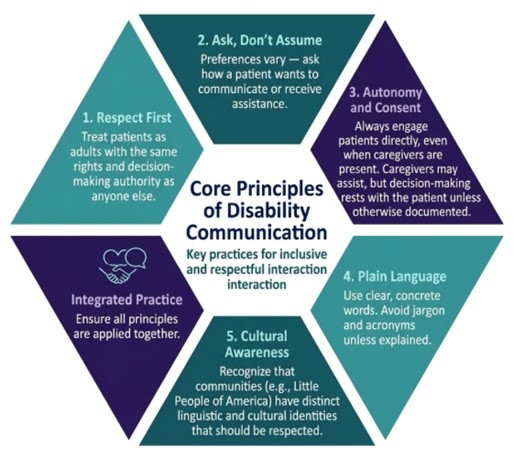
- Respect First: Treat patients as adults with the same rights and decision-making authority as anyone else.
- Ask, Don’t Assume: Preferences vary — ask how a patient wants to communicate or receive assistance.
- Autonomy and Consent: Always engage patients directly, even when caregivers are present. Caregivers may assist, but decision-making rests with the patient unless otherwise documented.
- Plain Language: Use clear, concrete words. Avoid jargon and acronyms unless explained.
- Cultural Awareness: Recognize that communities (e.g., Little People of America) have distinct linguistic and cultural identities that should be respected.
Disability-Specific Communication Strategies
- Deaf & Hard of Hearing
- Blind or Low Vision
- Intellectual & Cognitive Disabilities
- Physical Disabilities
- Chronic Illness & Invisible Disabilities (Spoonies)
Deaf & Hard of Hearing
- Provide qualified interpreters when requested; avoid relying only on lip reading or note writing, which can be unreliable.
- Speak directly to the patient, not the interpreter. Use first-person pronouns and normal pacing.
- In group settings, identify speakers clearly.
- Avoid shouting. Hearing assistive devices are calibrated for normal speech.
Video: Communication Through a CODA’s Perspective
This clip offers insight into the lived experience of a Child of Deaf Adults (CODA), highlighting how communication access, interpreter use, and provider assumptions can shape healthcare encounters for Deaf families.
Video: Why Live Interpreters Matter
In this clip, a Deaf individual explains why live, qualified interpreters are often preferred in healthcare settings and how alternative communication methods can create barriers to understanding, autonomy, and trust.
Further Resources for Learners
Blind or Low Vision
- Introduce yourself by name and role each time you engage.
- Offer to guide by letting the patient hold your arm; don’t grab mobility aids or service animals.
- Provide materials in large print, braille, or screen-readable formats; electronic medical records should accommodate these needs.
- Describe environments and orient patients clearly, especially when leaving them in new spaces.
Resources for Translating to Braille
Further Resources for Learners
Intellectual & Cognitive Disabilities
- Communicate directly with the patient using simple, concrete language.
- Break down complex concepts into smaller steps. Use visual aids, drawings, or models when helpful.
- Allow extra time for processing and response; avoid rushing.
- Verify understanding by rephrasing or asking open-ended questions.
Optional YouTube Video:
“Communication: Speaking to people with a learning disability” – a video including voices of those with intellectual disabilities.
Further Resource for Learners
Physical Disabilities
- Treat mobility devices as part of personal space; don’t lean or push without permission.
- Position yourself at eye level when speaking with a wheelchair user.
- Ensure accessible environments, clear pathways, unlocked ramps, reachable items; to remove communication barriers created by the setting.
Further Resources for Learners
- CMS.gov – Improving Access to Care for People with Disabilities
- Little People of America – Inclusion, Diversity, Equity, and Accessibility
Chronic Illness & Invisible Disabilities (Spoonies)
- Maintain calm, supportive communication.
- Respect disclosure – not all disabilities are visible; ask what accommodations may help.
Further Resources for Learners
Reflection Prompt for Learners:
How might you respond if a patient and their family prefer different language when talking about disability?
Common Pitfalls to Avoid
- Assuming caregiver control: Physicians often default to speaking with caregivers instead of the patient; this undermines autonomy.
- Over-reliance on inadequate methods: Lip reading or written notes may exclude essential nuance.
- Ignoring accessibility of materials: Few practices provide braille or large-print resources, which violates accessibility standards.
- Speaking down or infantilizing: Avoid “baby talk” or excessive simplification that strips patients of agency.
Practice Scenarios for Genetic Counselors
Results Disclosure: Instead of only telling caregivers, address the patient directly: “I want to explain these results to you. If it helps, I can also share a written summary.”
Session Preparation: Ask at intake: “Do you have a preferred way for us to share information – spoken, written, interpreter, or another format?”
Counseling in a group: With Deaf patients and interpreters present, maintain eye contact with the patient, not the interpreter.
Key Takeaways
🔑Takeaway 1
Effective communication is a legal duty in a clinical necessity.
🔑Takeaway 2
Ask about preferences and prioritize them.
🔑 Takeaway 3
Engage patients directly to support autonomy, unless otherwise stated.
🔑 Takeaway 4
Adapt communication methods to disability type, not all approaches work universally.
🔑 Takeaway 5
Respectful, culturally aware, strategies, build trust, dignity, and inclusion.
Reflection Prompt for Learners:
Think of a clinical encounter where communication barriers may have affected patient care. How could you have adjusted your approach to better support autonomy and inclusion?
1.3 Considerations
Barriers to Health Care and Inclusion
People with disabilities face persistent inequities that extend far beyond individual health conditions. Many poor outcomes are not caused by disability itself, but by systemic and social barriers.
Physical barriers
Inaccessible medical offices, exam tables, diagnostic equipment, transportation create constant hurdles.
Attitudinal barriers
Stigma, stereotypes, and provider bias can lead to dismissal of symptoms, assumptions about quality of life, and inadequate health care.
Communication barriers
Lack of sign language interpreters, inaccessible written materials, or limited provider training, restrict equitable care.
Policy and cost barriers
Inadequate insurance coverage, high out-of-pocket costs, and fragmented services prevent many from receiving necessary care.
Environmental and social barriers
Poverty, unemployment, poor housing, and lack of community wellness programs, increase health risks and reduce access to resources.
Video: Accessibility and Health care Environments
This video explores how accessibility, or lack thereof, is shaped by health care systems, physical spaces, and institutional design rather than individual disability.
Video: Accessibility in Practice
This clip shares a personal story illustrating how inaccessible environments affect healthcare access, dignity, and autonomy.
Inequities in Health Outcomes
- People with disabilities are more likely to experience chronic health conditions such as obesity, cardiovascular disease, and diabetes — often because of reduced access to preventative care.
- During COVID-19, individuals with disabilities were more likely to contract the virus and face severe outcomes, revealing systemic gaps in emergency preparedness.
- Many studies show higher rates of avoidable deaths from treatable conditions in people with intellectual and developmental disabilities due to inadequate care.
Real-World Examples with Statistics
Relevant Statistic: According to 2022 Behavioral Risk Factor Surveillance System (BRFSS) data now reported in DHDS, more than a quarter of adults in the United States (28.7%) report having a functional disability. That means an estimated 70 million Americans navigate daily life with challenges in hearing, vision, mobility, cognition, self-care, or independent living.
Example 1: A patient who uses a wheelchair may miss cancer screenings if exam tables and imaging machines are not accessible.
Example 2: Deaf patients are frequently asked to “get by” with lip reading instead of being provided interpreters, leading to miscommunication and unsafe care.
Example 3: Families report being turned away from clinics that lack training or willingness to accommodate developmental disabilities.
Example 4: In community settings, inaccessible gyms and wellness programs exclude people with disabilities from preventative health opportunities.
Video: What Inclusive Environments Look Like: Patient Perspective
Rebekah describes what inclusive health care environments look like when access needs are anticipated and patient preferences are actively sought. This narrative highlights the role of genetic counselors in proactively preparing for access needs.
Relevant Statistic: People with disabilities experience health disparities and are more likely to report certain health conditions. For example, in 2022, 43.6% of people with disabilities reported experiencing depression compared to 13.7% of people without disabilities.
Further Resources for Learners
Considerations for Genetic Counselors
Equity is systemic: recognize that barriers are built into policies, infrastructure, and professional training – not simply individual challenges.
Video: When Systems are Inaccessible
This video demonstrates how inaccessible environments and systems create barriers to care and independence. It reinforces the biopsychosocial model of disability and the role of health care systems in shaping patient experiences.
Intersectionality matters: women, immigrants, and people with multiple marginalized identities face compounded inequities.
Video: Deaf Plus Identities
This clip highlights the experiences of individuals who identify as Deaf and live with additional disabilities (“Deaf Plus”). It emphasizes the importance of recognizing layered communication needs and avoiding one-size-fits-all assumptions when supporting Deaf patients in health care settings.
Wellness gap: most health care systems emphasize acute care but failed to provide access to ongoing wellness and self-management programs.
Key Takeaways
🔑Takeaway 1
Barriers to health care for people with disabilities are structural, attitudinal, financial, and systemic.
🔑Takeaway 2
Inequities are note inevitable – they result from modifiable systems and policies.
🔑 Takeaway 3
Awareness of these issues enables counselors to advocate for accessible care, adapt communication, and support patients more equitably.
Reflection Prompt for Learners:
Think about a structural barrier you have observed in a healthcare setting (e.g., physical, financial, or policy-based). How might it affect a patient with a disability differently than a patient without a disability?